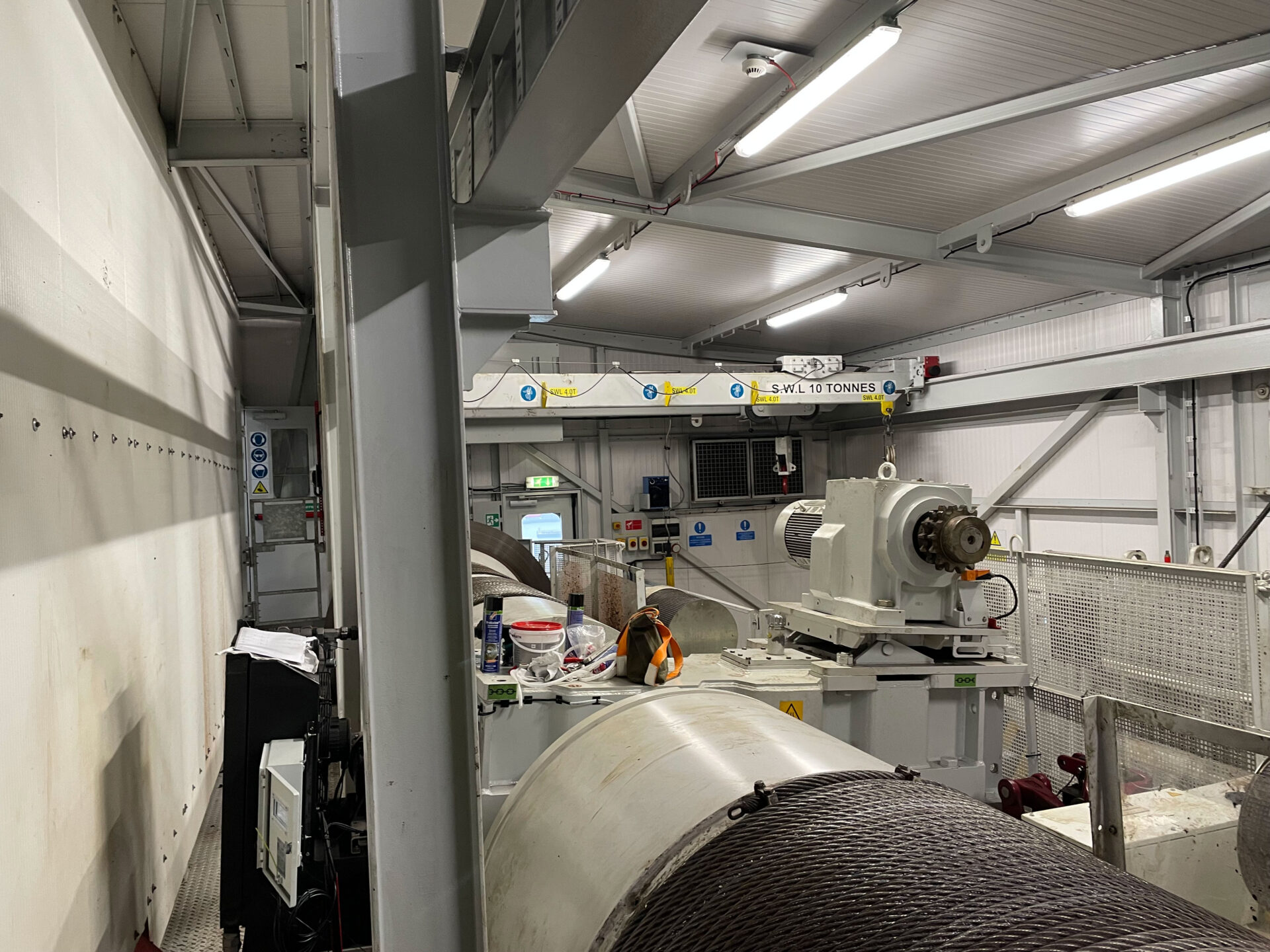
The Challenge: Invisible Wear at Great Heights
The main hoists of STS cranes operate under extreme load cycles. Inspecting the barrel couplings installed in these systems is traditionally complex and dangerous, requiring access at great heights and often necessitating facility downtime. A further issue: Misalignment in the drive train often goes unnoticed during visual inspections but can drastically reduce coupling service life. This was exactly the scenario threatening a main hoist at HHLA.
The Solution: Continuous Precision Monitoring
To make the condition of the couplings transparent, HHLA installed the MALMEDIE® LifeMonitor. Sensors continuously record the wear status with a precision of up to 0.1 mm.
The data analysis revealed an immediate need for action:
- Left Coupling: Extreme wear of approx. 8 mm per year. Without intervention, this would have meant a remaining service life of less than one year.
- Right Coupling: Also showed elevated wear, unnecessarily shortening operating time.

The Solution: Targeted Service Instead of Unplanned Downtime
Based on the alarming data, the MALMEDIE Service Team performed a MIC-Check in April and realigned the drive system. The effect was immediately visible on the LifeMonitor dashboard.

The Result: 5 Years of Service Life Secured
The realignment brought the wear rate almost to a halt. The data proves the success impressively:
- Wear Reduction: From a critical 8 mm/year down to a minimal 0.42 mm/year.
- Life Extension: The projected remaining service life of the affected coupling increased from just a few months to 5 years.
- Reliability: The right coupling now theoretically achieves up to 20 years of service life (in new condition).
Conclusion
With the LifeMonitor, HHLA successfully shifted from reactive maintenance (“repair on failure”) to a predictive maintenance strategy. This saves costs, increases personnel safety, and ensures that the cranes at the Port of Hamburg operate reliably.
